⚑ Simulated engagement — methodology reflects real practice
PawCart is a composite. The brand name, the specific numbers and the dashboard screenshots are illustrative. The diagnostic framework, SQL patterns, reconciliation approach and delivery cadence are identical to engagements I run with real clients. Real client work is confidential by default; a simulated case study lets me show the method end-to-end without breaching that.
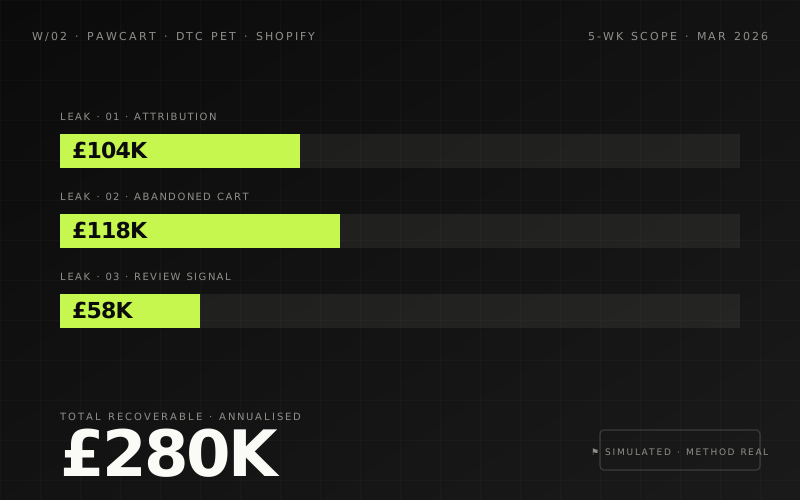
Every DTC brand doing £1M+ has some version of the same problem: three tools, three numbers, and a founder who's stopped trusting any of them. PawCart — a Shopify-based pet-food brand — came in with exactly that. Five weeks later they had one number, a roadmap, and £280K of previously-invisible revenue pinned to specific fixes.
The setup
PawCart does £3.2M run-rate on Shopify. Spends ~£35K/month on Meta and Google. Two-person marketing team, one fractional CFO, founder CEO. Six months ago they hired a growth agency who "improved ROAS by 40%" — which the founder has never believed, because the Shopify P&L didn't move.
That gap — between what the ads dashboard says and what the bank account says — is where every engagement I run starts.
Week 1 — reconciliation
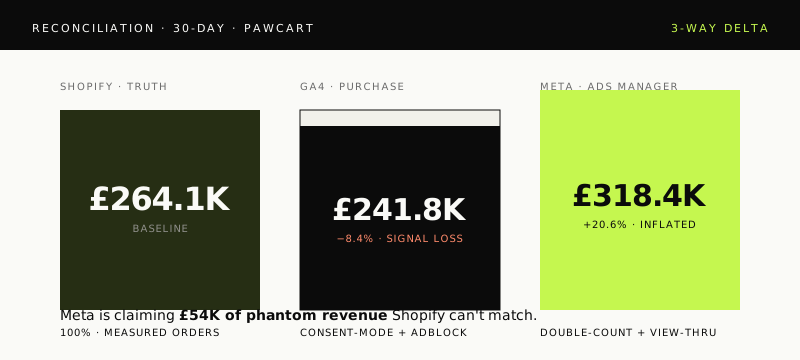
Before looking for leaks, I build a three-way reconciliation: Shopify orders, GA4 purchase events, Meta conversions. Same window, same revenue definition, same attribution model. Every engagement reveals the gap; the interesting part is where the gap is.
| Source | Revenue (30d) | vs. Shopify | Diagnosis |
|---|
| Shopify (truth) | £264,100 | — | Baseline |
| GA4 purchase | £241,800 | -8.4% | Consent-mode signal loss + ad blockers |
| Meta Ads Manager | £318,400 | +20.6% | Double-count + view-through inflation |
Meta is claiming £54K of revenue that Shopify doesn't have a matching order for. That's the agency's "40% ROAS improvement" in one table.
The three leaks
Leak · 01 · Attribution
Meta pixel double-counts on purchase refresh
Purchase event fires on /thank-you page load. A meaningful share of customers refresh to save the page, which fires the pixel again. Meta has no dedupe key set up server-side. Result: ~12% inflation on top of view-through — enough to make the worst-performing campaigns look break-even.
Fix: CAPI with event_id dedupe, plus server-side purchase confirmation from Shopify webhook.
£104K
Mis-allocated budget · annualised
Leak · 02 · Abandoned cart
Post-add-to-cart flow has three unfired triggers
Klaviyo flow fires on Added to Cart, but three specific conditions silently skip it: customer not logged in, checkout initiated in-app, and discount-code flows. Combined, about 34% of abandoned carts never received the recovery email. Standard industry recovery rate on this segment is 8–12%.
Fix: Shopify checkouts/create webhook → server-side Klaviyo track. Two-day build, one-day QA.
£118K
Recovered revenue · annualised
Leak · 03 · Review signal
Product reviews not syndicated to Google Shopping
900+ product reviews collected in Okendo. Aggregate rating is shown on product pages but not exposed via AggregateRating schema. Google Shopping therefore shows no seller rating — competitors in pet-food category all show stars. Baseline CTR lift from stars in PLAs is ~17% on comparable categories.
Fix: Okendo already has a Google integration turned off by default. Flip it. Two hours.
£58K
Signal lift · annualised
Delivery cadence
Week 1
Stakeholder interviews. Warehouse access. Three-way reconciliation.
Week 2
Attribution teardown. Meta pixel + GA4 audit. Findings draft.
Week 3
Findings delivered. Priorities confirmed with founder + CFO.
Week 4
Build: CAPI dedupe + Klaviyo webhook + Okendo Google sync.
Week 5
Reconciliation dashboard live. Handover doc. 30-day support.
The one-page dashboard
Every engagement ends with one page the operator actually checks. Not twelve dashboards, not a monster deck — one page, weekly. For PawCart it had six tiles: revenue (Shopify truth), GA4 vs. Shopify delta, CAC by channel, 30-day LTV, abandoned-cart recovery %, and review-signal CTR.
"Don't trust a dashboard you couldn't explain to your mum in 90 seconds." — what I tell every new client on kickoff.
What the numbers mean
£280K of recoverable revenue is the signal, not the guaranteed lift. The three fixes above usually capture 50–70% of that over six months, with the rest decaying into noise as customer behaviour adapts. A responsible consultant writes it as a range, not a promise. Any consultant who'll stand behind a single number on five weeks of data is selling you something.
£
Engagement fee · for referenceFive-week fixed-scope engagement like this prices at £6,000–£8,500 depending on warehouse readiness, with an optional £1,000/mo retainer for the first three months post-handover. That retainer catches about 80% of the regressions I see in the 60-day window after delivery.
Written by · March 2026
Jimmy Okoth
Independent data consultant · actuary · EMEA